
Best AHU Unit Manufacturers in China for Global Buyers
Choosing among the best AHU unit manufacturers in China takes more than comparing catalog prices. A unit may look impressive on a specification sheet, yet perform poorly if airflow, filtration, controls, and site conditions are mismatched. Global buyers need evidence they can check: product drawings, test reports, component details, and clear answers about service support.
ASHRAE HVAC author John Murphy’s systems-focused work offers a useful buyer’s principle: “An AHU performs well only when its components work as one system.” That is the right lens for this guide. Compare fan efficiency, coil design, casing insulation, filter access, and control options. Ask whether the manufacturer can adapt voltage, connection layouts, and documentation to your project. Small details matter. A filter door that opens into a pipe rack can complicate routine maintenance.
Chinese manufacturers serve a wide range of projects, from compact commercial units to large custom-built systems. Their capabilities vary, so claims deserve verification. Request references for similar applications, not just a polished factory video. Check production quality, delivery planning, spare-parts availability, and who handles commissioning questions across time zones. A low initial quote can hide gaps in scope. And even a strong supplier may not be the best fit for every project.
This overview helps global buyers compare manufacturers with practical criteria rather than rankings alone. It also leaves room for uncertainty: specifications do not reveal every service experience, and buyers should confirm critical details directly before ordering.
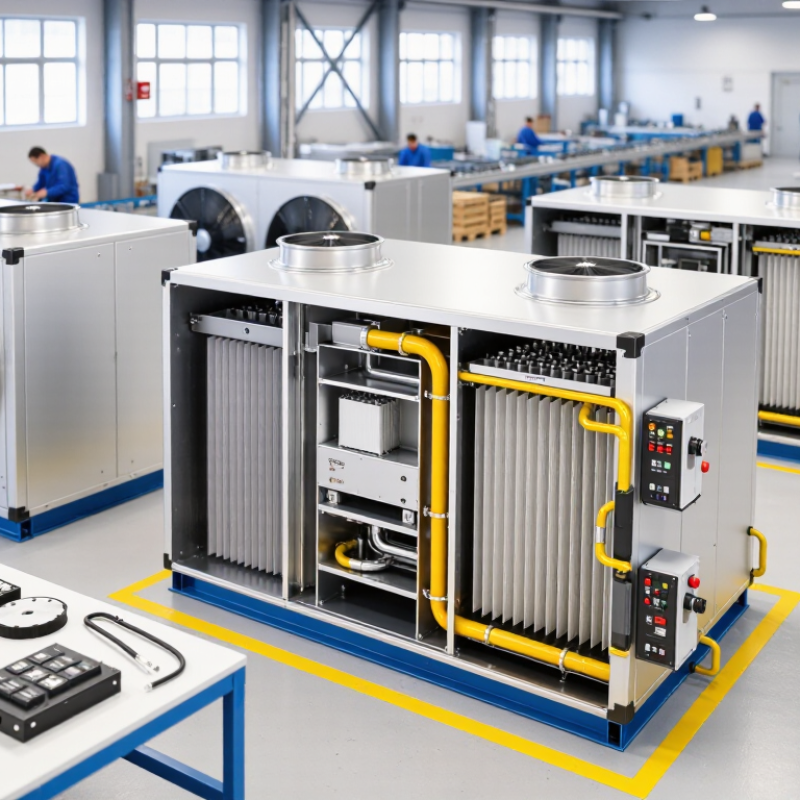
AHU Fundamentals: Airflow, Filtration, and EN 1886 Casing Performance
An air-handling unit works only as well as its airflow path allows. Undersized coils, abrupt transitions, or poorly placed dampers can create uneven flow and extra fan energy. Airflow first. During a factory review, compare the design airflow with measured results, and ask how readings were taken. A neat drawing is helpful, but it cannot reveal every pressure loss or leakage point.
Filtration depends on the dust load, target indoor conditions, and available fan pressure. A finer filter may capture more particles, yet its rising resistance can reduce airflow if the fan selection is wrong. Check filter seating, gasket compression, and access for replacement; bypass around a loose frame defeats the filter itself. EN 1886 evaluates casing characteristics such as strength, air leakage, thermal transmittance, and thermal bridging. These ratings describe the casing, not the unit’s complete operating performance. Global buyers should request test evidence for the offered casing configuration, not just a generic brochure. Door seals and panel joints can vary between production runs. I would inspect those details on a real sample; paperwork alone can feel reassuring, but sometimes it is not enough.
Best AHU Unit Manufacturers in China for Global Buyers — AHU Fundamentals: Airflow, Filtration, and EN 1886 Casing Performance
A brand-neutral technical checklist for comparing air handling units (AHUs). Confirm the required operating conditions and request project-specific selections and test documentation when evaluating suppliers.
| Evaluation dimension | Key data or classification | What global buyers should check |
|---|---|---|
| Airflow capacity | Specified in m³/h or L/s; there is no single standard AHU airflow range. Airflow is selected for the project’s ventilation and heating or cooling requirements. | Check the duty point, external static pressure, air density assumptions, and whether the stated airflow is for supply air, return air, or exhaust air. |
| Airflow calculation | Q = v × A, where Q is airflow in m³/s, v is average air velocity in m/s, and A is free cross-sectional area in m². For example, 10,000 m³/h at 2 m/s requires about 1.39 m² of free area. | Use the calculation as an initial sizing check only. Confirm actual section dimensions, velocities, pressure losses, and fan selection in the submitted design. |
| Filtration classification | ISO 16890 classifies general ventilation filters by reported particulate-matter efficiency: ISO Coarse, ISO ePM10, ISO ePM2.5, and ISO ePM1. | Request the filter’s ISO 16890 test classification and efficiency data. Choose the target class based on the project’s outdoor-air quality, indoor-air objectives, and applicable local requirements. |
| Filter arrangement | AHUs may use one or more filter stages; the arrangement and filter class depend on the application and design specification. | Check clean and final filter pressure drops, available filter face area, access for replacement, sealing, and whether the unit includes differential-pressure measurement points. |
| EN 1886 casing mechanical strength | Classes D1, D2, and D3 describe casing deflection under the standard’s test conditions. D1 is the most stringent class; the class limits are D1 ≤ 4 mm/m and D2 ≤ 10 mm/m. | Ask for the declared EN 1886 class and test evidence. Confirm that the tested casing construction corresponds to the offered unit configuration and size. |
| EN 1886 casing air leakage | Classes L1, L2, and L3 classify casing leakage under specified test pressures; L1 is the tightest class. Common EN 1886 limits at −400 Pa are L1 ≤ 0.15, L2 ≤ 0.44, and L3 ≤ 1.32 L/s·m². | Compare leakage class and test pressure, and clarify whether the declared result applies to negative pressure, positive pressure, or both. Leakage performance can affect energy use and air quality. |
| EN 1886 thermal transmittance | Classes T1–T5 describe casing thermal transmittance in W/(m²·K). T1 is the best-performing class; the T1 limit is below 0.5 W/(m²·K). | Request the declared class for the offered casing. Consider the operating climate, condensation risk, and insulation requirements when comparing units. |
| EN 1886 thermal bridging | Classes TB1–TB5 describe casing thermal-bridge performance. TB1 is the highest class and TB5 the lowest. | Check the declared TB class alongside the thermal-transmittance class, especially for cold climates, low-temperature air, or applications where surface condensation is a concern. |
| Fan and system pressure | Fan selection depends on the required airflow and the total system pressure, including AHU components and connected ductwork. No fan power or pressure value is universal. | Request the fan curve and selection point, motor and drive details, and pressure-drop breakdown for filters, coils, dampers, and other components. |
| Documentation and verification | Relevant references include EN 1886 for AHU casing performance and ISO 16890 for general ventilation filter classification. | Verify the applicable standard editions, test reports, declared classes, operating conditions, and whether documentation covers the exact casing and component configuration being quoted. |
Note: EN 1886 classes describe specified casing performance characteristics; they are not a substitute for a complete AHU selection. Confirm project airflow, pressure, filtration, climate conditions, and applicable local codes with the design team.
Related Posts
-
What Is an AHU Unit and What Types Are Available?
-
2026 Best Air Handling Unit for Global Buyers?
-

China Best Air Handling Unit Manufacturers How to Choose?
-

Top Blender Products to Buy in 2026 What Are the Best Choices?
-
Top 5 Tips to Choose the Best Company HVAC System?
-

Exploring the Best Air Handling Units in 2026 Trends and Innovations?