
China Top 10 HVAC Air Conditioner Suppliers
China is a major manufacturing base for air-conditioning equipment, serving residential, commercial, and industrial markets. The International Energy Agency’s 2018 report, The Future of Cooling, estimates that air conditioners and fans account for nearly 20% of electricity use in buildings worldwide. It projects the global stock of air conditioners could grow from 1.6 billion units in 2016 to 5.6 billion by 2050. These figures show why efficiency, product reliability, and after-sales support matter alongside purchase price. Cooling demand is real. So are the operating costs.
This guide to China’s top 10 HVAC air conditioner suppliers is intended to help buyers compare manufacturers with clearer criteria. It considers factors such as product range, export experience, certifications, energy-performance information, and service capabilities. These details can vary by model and destination market, so buyers should verify current specifications directly with each supplier. A polished catalogue is not proof of consistent quality. Factory audits and sample testing can reveal useful details, though they take time and may not answer every question. There is no perfect shortlist. The companies covered here offer a starting point, not a substitute for technical review. For procurement teams, matching equipment to climate, building size, installation conditions, and maintenance resources is often more useful than choosing by brand recognition alone.
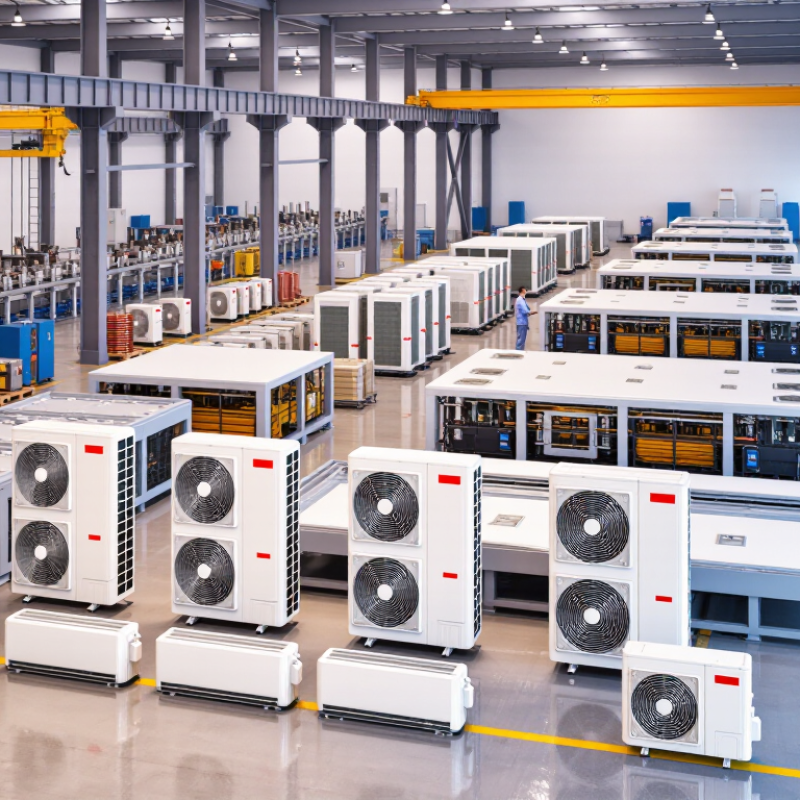
China’s HVAC Air Conditioner Supplier Landscape
China’s HVAC air-conditioner supplier landscape is broad, shaped by large-scale manufacturing, component networks, and growing demand for efficient cooling. The International Energy Agency’s 2018 report, The Future of Cooling, estimates that global energy use for space cooling has more than tripled since 1990. It could more than triple again by 2050 without stronger efficiency measures. This outlook puts pressure on suppliers to improve performance, not just increase output.
Chinese suppliers vary in factory scale, engineering support, and product focus. Some concentrate on residential split systems; others offer commercial equipment, heat pumps, or contract manufacturing. Buyers should compare rated capacity, seasonal efficiency, noise data, warranty terms, and access to replacement parts. Ask for test reports tied to the exact model, not a similar product. A polished catalogue is useful, but it does not prove consistent production. Factory audits help, though they can only show one moment in time.
Tips: Request sample data sheets and confirm the test conditions behind each efficiency figure. Check lead times for compressors, control boards, and other critical parts. Small details matter. Supplier comparisons are rarely perfect; shipping delays and specification changes can still upset a careful plan.
China Top 10 HVAC Air Conditioner Suppliers - China’s HVAC Air Conditioner Supplier Landscape
Anonymous supplier-segment profiles, not a ranked list of named companies. Capacity ranges are indicative examples; actual specifications, refrigerants, certifications, and availability vary by model and market.
| No. | Supplier Segment | Typical Equipment | Indicative Capacity Range | Common Refrigerant Options | Typical Applications | Buyer Verification Points |
|---|---|---|---|---|---|---|
| 1 | Residential room air conditioner manufacturers | Wall-mounted and floor-standing split air conditioners | Approximately 2–8 kW cooling capacity per indoor unit | R32 or R410A, depending on model and market | Apartments, houses, and small residential rooms | Rated capacity, seasonal energy performance, noise levels, applicable local product-safety and efficiency requirements |
| 2 | Light-commercial air conditioner manufacturers | Ceiling cassette, ducted, and ceiling-suspended split systems | Approximately 3.5–28 kW per system | R32 or R410A, depending on product design | Retail units, offices, restaurants, and small commercial premises | Airflow, external static pressure for ducted units, condensate management, controls, and installation requirements |
| 3 | Variable refrigerant flow system suppliers | VRF outdoor units connected to multiple indoor units | Commonly around 8–100 kW per outdoor module or combined system, depending on configuration | R410A and, in some newer product lines, R32 | Hotels, offices, schools, and multi-zone commercial buildings | Connected indoor-unit ratio, piping limits, operating-temperature range, control compatibility, and local code compliance |
| 4 | Air-cooled chiller and heat-pump suppliers | Packaged air-cooled chillers and reversible chiller heat pumps | Approximately 20–1,500 kW per unit or modular installation | Refrigerant varies by model; R410A, R32, and other specified options may be available | Commercial buildings, campuses, and light industrial facilities | Certified cooling and heating performance, outdoor operating limits, sound data, and water-side pressure drop |
| 5 | Water-cooled chiller suppliers | Water-cooled screw, centrifugal, or other vapor-compression chillers | Typically hundreds of kW to several MW, depending on type and configuration | Model-specific refrigerants; verify the exact refrigerant and applicable phase-down rules | Large commercial buildings, district cooling, and industrial plants | Full- and part-load efficiency, certified rating data, cooling-tower requirements, water quality, and service support |
| 6 | Rooftop and packaged-unit suppliers | Factory-assembled packaged air-conditioning units | Approximately 10–300 kW, with larger project-specific systems available | R32 or R410A on selected models; confirm the model specification | Supermarkets, halls, warehouses, and other open-plan spaces | Supply-air configuration, filtration options, economizer availability, weather protection, and service access |
| 7 | Precision cooling suppliers | Close-control air conditioners and computer-room cooling systems | Approximately 5–200 kW per unit, depending on room and system design | Refrigerant varies by product generation and system configuration | Data rooms, telecom facilities, laboratories, and technical spaces | Sensible cooling capacity, humidity control, redundancy design, alarms, controls integration, and operating envelope |
| 8 | Industrial process cooling suppliers | Process chillers, packaged cooling systems, and temperature-control units | From several kW to multi-megawatt plant capacity | Model- and application-specific; confirm refrigerant and process-fluid compatibility | Manufacturing, plastics processing, food production, and equipment cooling | Required leaving-fluid temperature, flow rate, process stability, materials compatibility, and continuous-duty capability |
| 9 | Heat-pump and hot-water system suppliers | Air-source heat pumps for space heating and domestic hot water | Approximately 5–500 kW thermal output per unit or cascade system | R32, R290, or other refrigerants depending on equipment design | Residential hot water, commercial heating, and low-temperature hydronic systems | Heating capacity at stated outdoor temperatures, water outlet temperature, safety provisions, and local refrigerant regulations |
| 10 | HVAC component and system-integration suppliers | Air-handling units, fan-coil units, coils, controls, and configured HVAC packages | Project-specific; capacity depends on airflow, coil selection, and connected heat-source equipment | Not applicable to air-side components alone; refrigerant depends on the connected system | Commercial buildings, public facilities, and engineered projects | Airflow and pressure data, filtration class, coil performance, control protocols, documentation, and integration scope |
Related Posts
-
2026 Top HVAC Technology Trends for Global Buyers
-
Why Are Air Handling Systems Essential for Indoor Air Quality?
-

Why Choosing the Right HVAC Equipment is Crucial for Your Home Comfort
-
2026 Best HVAC Equipment for Global Buyers to Consider?
-
Top 10 HVAC Equipment Picks for Efficient Home Heating and Cooling in 2023
-
How to Choose the Right Industrial HVAC System?