What Are the Top Types of Transformers in China?
China’s transformer market serves dense cities, industrial parks, rail networks, and expanding renewable-energy projects. Its leading product groups include oil-immersed power transformers, distribution transformers, dry-type units, and specialized designs for traction, rectification, and renewable integration. Each meets a different operating need. A unit beside a city substation faces different space and cooling demands from one supplying a factory or wind farm.
This guide explains the Types Of Transformers most relevant to China’s market and the practical differences between them. It considers voltage level, capacity, insulation, cooling, installation environment, and application. These details matter. A dry-type transformer may suit an indoor building, while an oil-immersed model is often selected for higher-capacity outdoor service. Amorphous-alloy distribution transformers may help reduce no-load losses, though purchase decisions also depend on operating conditions and lifecycle costs. There is no single “best” type.
China’s market is broad, and rankings can vary by year, region, and measurement method. Readers should check current product specifications and independent test data before comparing suppliers. A useful principle for this overview is: “Choose a transformer for its duty, not just its nameplate.” This is an editorially written summary, not a verified quotation. No expert name or source quotation was provided, so attributing it to a real specialist would be unreliable.
How China Classifies Transformers by Function, Voltage, and Cooling Method
In China, transformer types are easiest to understand through three lenses: function, voltage, and cooling. Power transformers move bulk energy between transmission levels, while distribution units step voltage down for factories, shops, and homes. Special-purpose designs serve furnace, traction, or rectifier loads. The boundaries are not always neat; one installation may need a tailored design.
Voltage labels reflect where a unit works in the grid. Common classes include 10 and 35 kV distribution, 110 and 220 kV transmission, and 500 kV or higher backbone links. China also operates 1,000 kV AC and ±800 kV DC projects. The China Electricity Council reported national electricity consumption of 9.22 trillion kWh in 2023, illustrating the scale these networks must serve.
Cooling affects safety, footprint, and maintenance. Oil-immersed units may use natural oil and air circulation, or fans and pumps for heavier loads. Dry-type units rely on air, making them useful indoors where limiting oil is important. Details matter. The IEA’s 2023 report, Electricity Grids and Secure Energy Transitions, says global annual grid investment needs to exceed $600 billion by 2030, up from about $300 billion. That expansion makes thermal performance consequential, though a neat category label alone cannot predict a transformer’s behavior on site.
What Are the Top Types of Transformers in China?
China classifies transformers by function, voltage level, and cooling method. The chart shows representative AC grid voltage classes in China—not transformer power ratings.
By function: common types include step-up transformers for generation, step-down transformers for transmission and distribution, distribution transformers, isolation transformers, and instrument transformers such as current and voltage transformers. By cooling: oil-immersed units commonly use ONAN or ONAF cooling; dry-type units commonly use air natural (AN) or air forced (AF) cooling.
Power Transformers for 110–1,000 kV AC Transmission Networks
What Are the Top Types of Transformers in China?
Across China’s 110–1,000 kV AC transmission networks, transformer roles depend on where power enters or leaves the grid. Generator step-up transformers raise voltage at power stations, helping electricity travel over long distances with lower transmission losses. Grid substations use interconnecting transformers, often autotransformers, to link voltage levels such as 500 kV and 220 kV. Receiving substations use step-down units to supply regional networks. Voltage levels vary by project and region; not every network uses every class.
Large units are commonly oil-immersed, with cooling systems that move heat away from windings and core. Their insulation must withstand high electrical stress, while tap changers help regulate voltage as grid conditions change. On site, specialists check temperature, oil condition, bushing health, and operating records. A small change can matter. Yet equipment specifications alone do not guarantee reliability; installation quality, maintenance, and local operating conditions count too. That part is easy to underestimate.
Tips: Match transformer capacity and voltage ratio to the substation’s load and network plan. Review cooling, insulation, and monitoring requirements before procurement. Ask how maintenance access will work in the actual site layout. A neat design on paper may still be awkward in the field.
Distribution Transformers: Common 10 kV-to-0.4 kV Supply Units
Distribution Transformers: Common 10 kV-to-0.4 kV Supply Units
In many Chinese distribution networks, a 10 kV feeder supplies a local transformer, which lowers voltage to 0.4 kV. That secondary voltage serves three-phase equipment and, through phase-to-neutral connections, ordinary 230 V loads. Simple in principle. In practice, engineers must match capacity to the load profile, not just peak demand. A lightly loaded unit can waste energy; an undersized one may run hot during evening peaks.
China’s National Energy Administration reported electricity consumption of 9.85 trillion kWh in 2024, up 6.8% year over year. This national figure signals rising demand, but it does not tell us how many local transformers are needed. Site-level load measurements still matter. Designers also consider feeder length, voltage drop, ambient temperature, and space for maintenance. A small detail, such as poor ventilation around an indoor unit, can undermine otherwise sound planning.
The International Energy Agency’s Electricity Grids and Secure Energy Transitions report says annual global grid investment needs to rise above US$600 billion by 2030. That is a system-wide estimate, not a China-specific transformer forecast. Still, it highlights the pressure on distribution infrastructure. For a 10 kV-to-0.4 kV unit, routine checks of connections, insulation, and temperature help catch problems early. The awkward part: maintenance schedules can look adequate on paper while missing local operating conditions.
Oil-Immersed and Dry-Type Transformers for Outdoor and Indoor Use
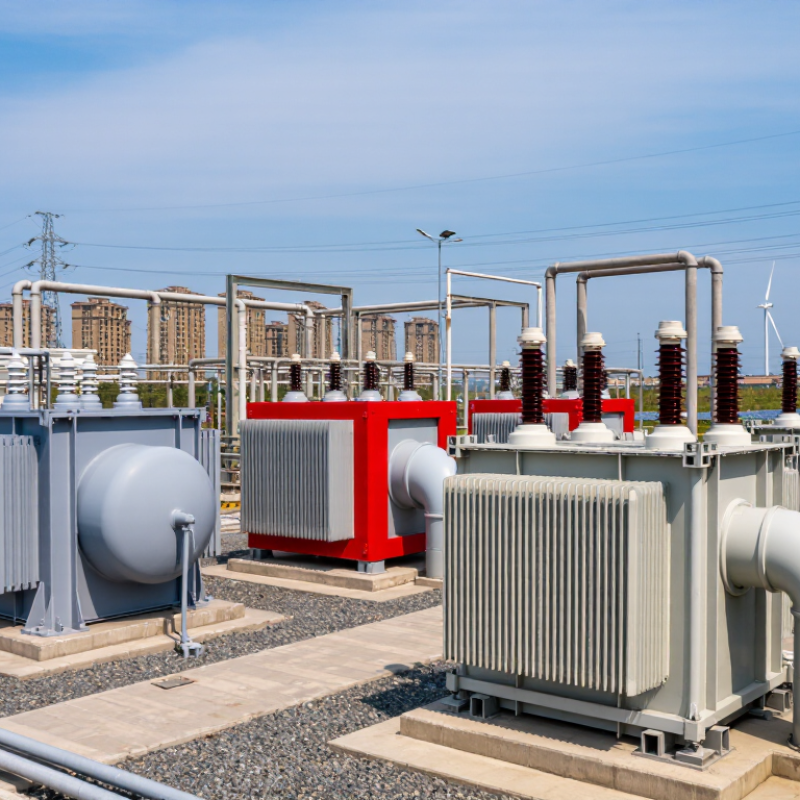
In China, transformer selection often starts with the installation site, not just rated capacity. Oil-immersed units use insulating oil to transfer heat and suit outdoor substations, where weather protection and accessible maintenance matter. A fenced pad, clear service access, and effective spill control are practical details. They are not optional afterthoughts. Dry-type units use air or solid insulation and are commonly chosen for indoor spaces such as commercial buildings, stations, and factories. They avoid liquid-oil leakage, but still need good ventilation and clearance around the enclosure.
Neither type fits every site. Oil-immersed equipment can offer effective cooling at higher loads, while dry-type equipment may simplify indoor placement where oil containment is difficult. Yet dry-type does not mean maintenance-free, and outdoor use requires a suitable enclosure and environmental protection. The International Energy Agency’s Electricity Grids and Secure Energy Transitions (2023) says annual grid investment must rise above USD 600 billion by 2030 to meet global needs. That figure is not China-specific, but it highlights the scale of grid upgrades shaping transformer demand. A common design mistake is treating “indoor” and “outdoor” as the only decision factors. Load profile, ambient temperature, fire strategy, noise limits, and maintenance access deserve equal attention. Sometimes the site drawings miss real access constraints. Check them early.
Specialty Transformers for ±800 kV UHVDC, Rail, and Industrial Applications
China’s specialty transformer segment is defined by three demanding roles: UHVDC conversion, railway traction, and heavy industry. At ±800 kV, converter transformers connect AC networks to valve halls while handling insulation stress, harmonics, and switching transients. State Grid project data lists the Xiangjiaba–Shanghai ±800 kV link at 6.4 GW. That is the link’s capacity, not one transformer’s rating. Precision matters. Transformer banks, cooling systems, and redundancy all affect reliable operation.
Rail traction transformers supply 25 kV AC systems, where train starts and stops create sharp load changes. Onboard units must also fit tight spaces and manage vibration. Industrial transformers serve rectifiers, furnaces, and electrolysis lines, where continuous heat and harmonic currents can shorten insulation life. Heat matters. The IEA’s 2023 report, Electricity Grids and Secure Energy Transitions, says 80 million kilometres of grids must be added or refurbished worldwide by 2040. That points to sustained demand for grid equipment, including converter transformers. One uncomfortable detail: high capacity alone does not guarantee availability; maintenance access and spare-part planning are easy to underestimate.
What Are the Top Types of Transformers in China? - Specialty Transformers for ±800 kV UHVDC, Rail, and Industrial Applications
| Transformer type | Typical application | Key design characteristics | Typical system or duty |
| UHVDC converter transformer | Converter stations in long-distance, ±800 kV-class ultra-high-voltage direct-current transmission projects | Connects the AC network to converter valves; designed for demanding insulation conditions, harmonics, and DC-related electrical stresses. | A ±800 kV DC link denotes the pole-to-ground voltage level; transformer winding arrangement and ratings are project-specific. |
| Railway traction transformer | Electric locomotives and high-speed trains supplied from electrified railway overhead lines | Onboard units are built for compactness, vibration resistance, and variable traction loads; they supply traction converters and auxiliary systems. | China’s electrified railways commonly use a 25 kV, 50 Hz single-phase overhead supply; onboard arrangements depend on the vehicle design. |
| Traction substation transformer | Railway traction substations that feed overhead contact systems | Configured for railway load patterns and the selected traction power-supply scheme; protection and insulation coordination are planned for the installation. | Commonly supplies single-phase traction power, with the primary connected to the utility grid and the secondary matched to the railway system. |
| Rectifier transformer | Industrial DC processes, including electrolysis and other high-current rectifier applications | Provides the voltage and phase-shift arrangement required by the rectifier; designed to withstand harmonic currents and high thermal loading. | Output voltage, current, winding configuration, and cooling method are selected to suit the rectifier and process duty. |
| Electric arc furnace transformer | Steelmaking and other electric-arc furnace operations | Designed for frequent load changes, high currents, and the electrical and mechanical stresses associated with furnace operation; tap changing is commonly used to adjust operating voltage. | Rating and secondary voltage depend on furnace capacity, electrode system, and process requirements. |
| Mining transformer | Power distribution for underground mines and mining equipment | May use flameproof or other mine-suited enclosures where required by the installation; design addresses restricted space, harsh conditions, and applicable safety requirements. | Available in configurations for different mine distribution systems; enclosure and protection requirements depend on the site classification. |
| Phase-shifting transformer | Transmission networks requiring control of active-power flow between interconnected lines | Introduces a controllable phase-angle shift to influence power flow; commonly uses a specialized winding and tap-changing arrangement. | Designed for the network’s voltage, power-flow range, and operating strategy; it does not convert AC power to DC. |
Note: System details and transformer specifications vary by project, equipment configuration, and applicable standards.